
Crow's feet: proven care and anti-aging rituals for 2026
Quick answer: Wrinkles around the eyes (crow's feet) respond well to a combination of red LED light therapy (660-850nm), retinol at 0.3-1%, and targeted peptides. Clinical studies show a 25 to 36% reduction in periorbital wrinkles after 12 weeks of regular LED sessions.
These expression lines, the first visible marks time leaves on the face, appear as early as 25-30 under the combined effect of intrinsic aging, sun exposure, and repeated contraction of the orbicularis muscle. Contrary to what people assume, scientifically validated non-invasive options can now soften their appearance significantly without injections.
Understanding crow's feet: anatomy and causes
Quick answer: Crow's feet are dynamic wrinkles caused by repeated contraction of the orbicularis oculi muscle, combined with the gradual loss of collagen and elastin in the thin skin around the eyes.
The periorbital zone has unique features that make it especially vulnerable to aging. Skin thickness there reaches only 0.5mm against 2mm on the rest of the face, according to a study published in the Journal of Cosmetic Dermatology. That extreme thinness explains why the first signs of age show up there first.
Several factors speed up crow's feet:
- Intrinsic aging : collagen production drops by about 1% a year after 25
- Photoaging : UV breaks down the collagen and elastin fibers you already have
- Repeated expressions : smiling and squinting work the orbicularis muscle up to 10,000 times a day
- Chronic dehydration : the periorbital zone holds few sebaceous glands
A study by Farage et al. (2008) shows that environmental oxidative stress accounts for 80% of visible skin aging, against only 20% for chronological aging. That figure underlines how much topical antioxidants matter in any anti-crow's-feet protocol.
LED light therapy: proven results on the eye area
Quick answer: Red light (630-660nm) and near-infrared (830-850nm) stimulate collagen production by fibroblasts, with a measured 36% improvement in skin texture after 12 weeks according to the reference study by Wunsch & Matuschka (2014).
Photobiomodulation works through light absorption by mitochondrial chromophores, cytochrome c oxidase above all. That activation stimulates cellular ATP production and sets off a signaling cascade that ends in increased neocollagenesis.
The controlled clinical study by Wunsch & Matuschka, published in Photomedicine and Laser Surgery, showed across 136 participants:
- Reduction in wrinkle depth: -36% on average
- Improvement in skin elasticity: +19%
- Higher dermal collagen density measured by ultrasound
For the eye area specifically, a study by Barolet et al. (2009) confirms what LED does for periorbital wrinkles, with significant improvement from 8 weeks of daily sessions.
The optimal parameters for crow's feet include:
- Wavelengths : red 660nm + infrared 850nm combined
- Irradiance : 30-50 mW/cm² for effective penetration
- Duration : 10-15 minutes per session
- Frequency : 3 to 5 sessions a week
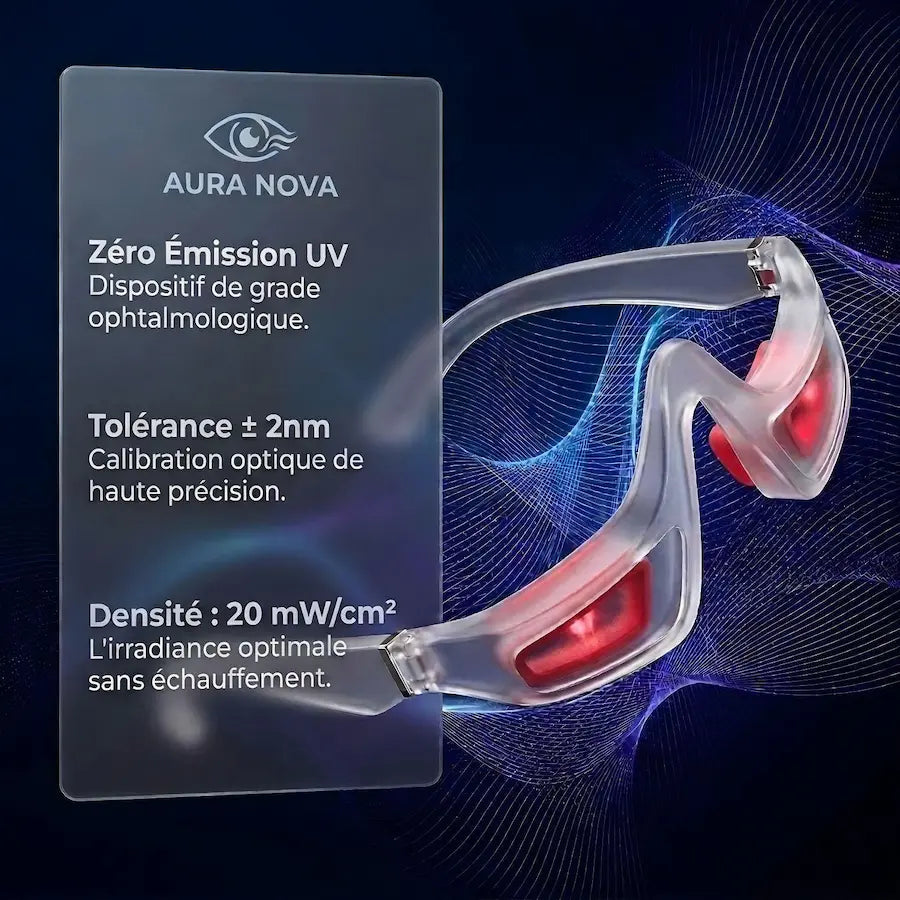
Under-eye LED masks dedicated to this zone, like the AURA NOVA, target it precisely with suitable irradiance, where a full face mask can lack precision on such a delicate region.
The most effective cosmetic actives
Quick answer: Retinol (0.3-1%), peptides (Matrixyl, Argireline), and stabilized vitamin C form the trio of scientifically validated actives against wrinkles around the eyes, with visible results in 8 to 12 weeks.
Retinoids: the gold standard
Retinoids remain the most scientifically documented anti-aging active. A meta-analysis published in the Journal of Drugs in Dermatology (2015) confirms they stimulate type I and III collagen synthesis while inhibiting the metalloproteinases that break it down.
For the eye area, go with:
- Encapsulated retinol at 0.3% to start, 0.5-1% once acclimated
- Retinal (retinaldehyde) : more effective than retinol, better tolerated than retinoic acid
- Application : evenings only, on dry skin, avoiding the mobile eyelid
Signal peptides and neuromodulators
Peptides act as cellular messengers that stimulate collagen synthesis or relax micro muscle contractions. The study by Robinson et al. (2005) shows a 17% reduction in wrinkle depth with Matrixyl after 12 weeks.
The peptides that work particularly well on crow's feet:
- Matrixyl (palmitoyl pentapeptide-4) : stimulates collagen I, III, and IV
- Argireline (acetyl hexapeptide-3) : relaxing effect on expression lines
- Syn-Coll (palmitoyl tripeptide-5) : mimics growth factor TGF-β
Vitamin C and antioxidants
Vitamin C (L-ascorbic acid) at 10-20% protects against oxidative stress while acting as an essential cofactor in collagen synthesis. A study by Fitzpatrick & Rostan (2002) reports significant improvement in fine lines after 12 weeks of daily use.
 A daily anti-crow's-feet ritual
Quick answer: An effective protocol combines a daily 10-minute LED session, actives applied morning and night, and gentle massage to stimulate microcirculation without stressing this fragile zone.
Morning ritual (5 minutes)
- Gentle cleanse : micellar water or cleansing milk, never a harsh foaming cleanser around the eyes
- Vitamin C serum : 2-3 drops tapped gently from the inner corner outward
- Hydrating eye care : a light peptide formula, applied with gentle pressure, never pulling
- Sunscreen SPF 30-50 : essential, reapply during long exposure
Evening ritual (15 minutes)
- Double cleanse : cleansing oil, then a gentle cleanser
- LED session : 10 minutes with targeted goggles or a full face mask. The AURA NOVA works specifically on dark circles and crow's feet at an optimal irradiance of 30 mW/cm²
- Retinol serum : after the LED, on perfectly dry skin, avoiding the lash line
- Rich eye care : a ceramide and hyaluronic acid formula for the night
Lymphatic drainage massage
Add 2 minutes of gentle massage each evening to stimulate microcirculation and support drainage:
- Light pressure from the inner corner toward the temples
- Gentle circular movements over the crow's feet
- Downward strokes along the neck to move the lymph
- A quartz or jade gua sha, used cold, amplifies the decongesting benefit
Common mistakes to avoid
Quick answer: The three big mistakes: skipping daily sun protection, applying retinol too aggressively around the eyes, and the impatience that piles on actives before skin has had time to answer.
Skipping sun protection
UV exposure drives 80% of visible skin aging. Skip daily SPF around the eyes and you cancel out the benefit of every anti-wrinkle step. Choose a non-irritating mineral formula suited to this sensitive zone.
Overdoing retinol
Skin around the eyes runs 40% thinner than the rest of the face. Apply the same retinol concentration you use elsewhere and you get irritation, flaking, and — paradoxically — sharper fine lines from dehydration. Start at 0.3% maximum, once every three evenings.
Piling on actives
Layering vitamin C, retinol, AHAs, and peptides in the same routine irritates the skin barrier. Alternate instead: vitamin C in the morning, retinol at night, acid exfoliants once or twice a week at most and never the same evening as retinol.
Expecting immediate results
The skin renewal cycle runs 28 days. The first visible results from LED or retinol appear between 4 and 8 weeks, and significant results on set-in wrinkles between 12 and 24 weeks. Consistency beats intensity.
Realistic results: what to expect
Quick answer: With a rigorous LED + topical actives protocol, expect visible radiance at 4 weeks, softer fine lines at 8 weeks, and a measurable reduction in crow's feet at 12 to 16 weeks.
A realistic timeline
| Period | Expected results |
|---|---|
| Weeks 1-4 | Better hydration, improved radiance, smoother skin to the touch |
| Weeks 4-8 | Dehydration lines soften, more even texture |
| Weeks 8-12 | Visible reduction in surface crow's feet (-25 to 36% across studies) |
| Weeks 12-24 | Deeper wrinkles improve, elasticity strengthens (+19%) |
Factors that shape your results
- Age : skin between 30 and 45 usually responds better than skin over 60
- Wrinkle depth : fine lines soften more easily than deep furrows
- Consistency : studies show you need 80%+ adherence for optimal results
- Lifestyle : sleep, hydration, and not smoking amplify the benefits
For a complete crow's-feet protocol, the AURA NOVA LED goggles (45€) offer excellent value among the devices available, letting you work on this zone precisely every day while you get on with something else.
Sources
- Wunsch A, Matuschka K, 2014 — A Controlled Trial to Determine the Efficacy of Red and Near-Infrared Light Treatment in Patient Satisfaction, Reduction of Fine Lines, Wrinkles, Skin Roughness, and Intradermal Collagen Density Increase
- Barolet D et al., 2009 — Regulation of Skin Collagen Metabolism In Vitro Using a Pulsed 660 nm LED Light Source
- Ruvolo EC et al., 2006 — Skin Properties in Different Body Sites: The Effect of Age and Ethnicity
- Farage MA et al., 2008 — Intrinsic and Extrinsic Factors in Skin Ageing: A Review
- Mukherjee S et al., 2006 — Retinoids in the Treatment of Skin Aging: An Overview of Clinical Efficacy and Safety
- Robinson LR et al., 2005 — Topical Palmitoyl Pentapeptide Provides Improvement in Photoaged Human Facial Skin
- Fitzpatrick RE, Rostan EF, 2002 — Double-blind, Half-face Study Comparing Topical Vitamin C and Vehicle for Rejuvenation of Photodamage
Consistency remains the key to any anti-crow's-feet protocol. A simple but steady ritual — 10 minutes of LED, a few drops of the right serum — transforms skin more than occasional intensive procedures. The eye area deserves that daily attention: it's the first place to reveal the vitality in your gaze.